

5 Factors That Affect How Long Concrete Takes to Cure
October 1, 2026
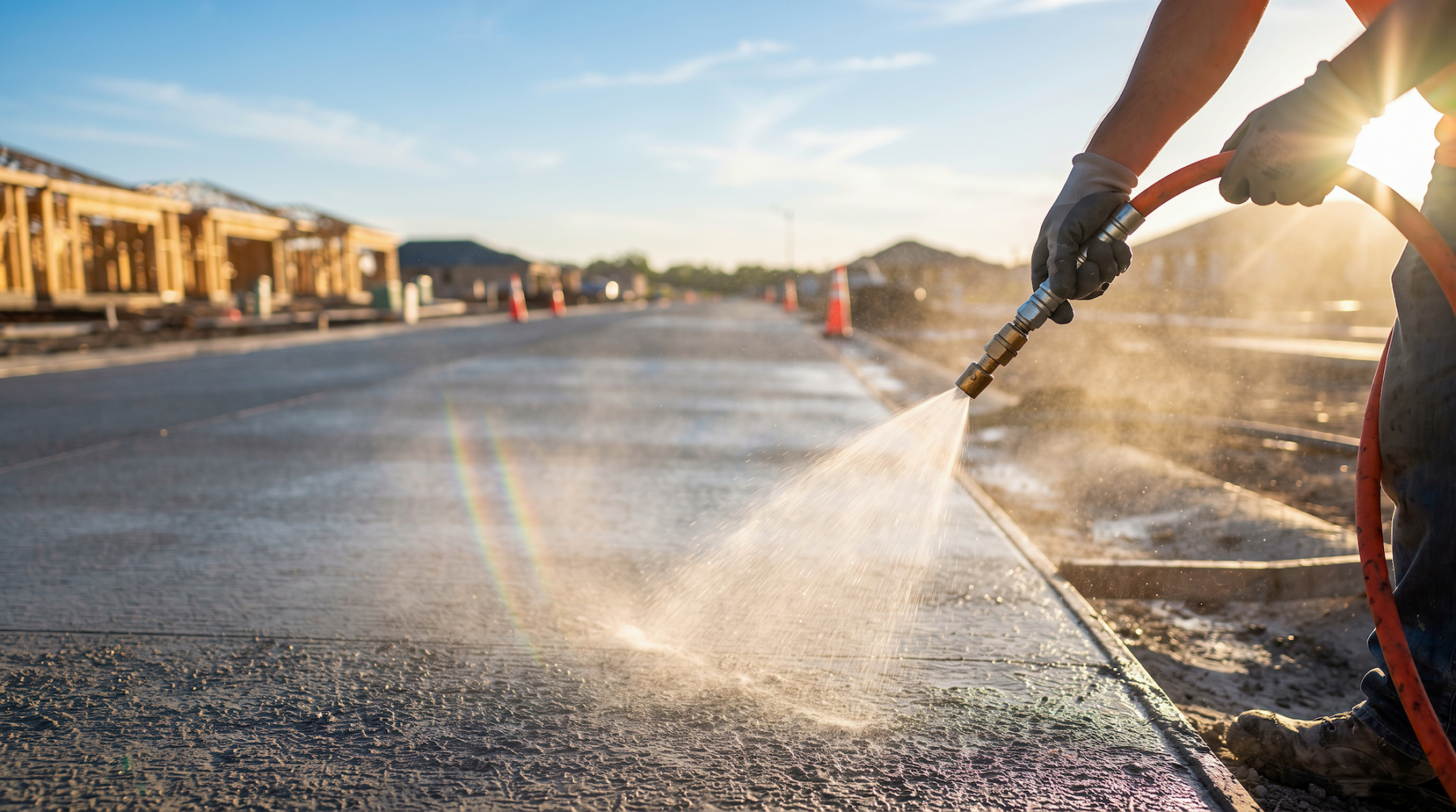
Concrete begins curing as soon as cement and water react, but the rate of that process can vary significantly from one placement to the next. A driveway that can support passenger vehicles after about a week in mild weather may require more time when temperatures drop or the mix design changes. Five factors have the greatest influence on that timeline, with three determined before the concrete leaves the batch plant and two shaped by conditions after it reaches the site.
1. How Water-Cement Ratio Affects Concrete Curing Time
The water-cement ratio measures how much water goes into the mix for every pound of cement. Keeping that ratio within the mix specification limits the excess water left behind as the concrete hardens, creating a denser cement paste with fewer internal voids. Exterior concrete exposed to freezing is commonly specified with a relatively low water-cement ratio for that reason.
Plants account for the moisture already carried in sand and stone when calculating batch water, so the proportions stay within the mix design as material enters the drum. Adding water at the site to loosen a stiff load changes those proportions. Too much added water can leave more capillary voids after the excess moisture leaves the concrete, reducing the strength the hardened mix can reach.
2. Does Cement Blend Change Concrete Curing Time?
Cement blend decides how quickly that measured water turns into hardened paste. Straight portland cement reacts fastest in the first days after placement. Mixes that replace part of the cement with fly ash or slag gain psi more slowly at early ages, though they often match or pass a straight-cement mix at later test ages.
The reaction in a fly ash mix drops off sharply once concrete temperature falls below about 40°F. A blend that works well on a July foundation may call for a different design on a late-fall pour for that reason.
3. Can Admixtures Speed Up Concrete Curing?
Admixtures change the curing clock without changing the basic recipe. An accelerator shortens set time and speeds early psi gain, which matters when cold weather leaves only a few warm hours each day. Calcium chloride is a widely used accelerator, typically dosed at 1 to 2 percent of the cement weight.
Chloride promotes corrosion in reinforcing steel, so rebar and wire mesh call for a non-chloride accelerator instead. A hydration-stabilizing admixture works in the opposite direction, holding the mix workable through a long haul or a hot afternoon so placement and finishing stay on schedule.
4. How Does Temperature Affect Concrete Curing Time?
Concrete temperature is one of the biggest influences on curing time, and it decides whether a slab holds the pace the mix set at the plant. A slab at 70°F gains psi roughly twice as fast as the same slab in the low 50s. Fresh concrete also has to be kept from freezing until it reaches about 500 psi, which usually takes the first day or two in cold conditions.
Helena’s first fall frost typically arrives in late September, so a slab poured there in October may need heated mix water, insulated blankets, or an accelerated mix to reach that threshold before the first hard overnight freeze. Thin flatwork and elevated decks lose heat fastest, since they have the least mass holding the warmth that hydration gives off.
5. Why Moisture Matters During Concrete Curing
Surface moisture decides whether hydration keeps going through the first week or stops short, even after the slab is protected from cold. Cement needs water to react, and a slab that dries out early stops gaining psi near the top while the interior keeps curing. The weaker surface layer that results is prone to dusting and fine cracking.
Low humidity, wind, and direct sun all pull water out of fresh concrete faster. A dry climate with less than a foot of precipitation a year, and warm downslope winds that can spike afternoon evaporation, strips surface water fastest of all. A curing compound or plastic sheeting placed as soon as finishing wraps up keeps that water in the slab. Seven days of moist curing is a common minimum for standard flatwork, with longer periods for blended mixes that gain psi more slowly.
Concrete Curing Time From Plant to Slab
The mix that leaves the plant sets the foundation for how quickly strength develops, but the conditions surrounding the pour determine whether that pace continues after placement. Water-cement ratio, cement blend, and admixtures establish the starting point, while temperature and surface moisture keep hydration moving once the concrete is in place. Bringing those factors together before the pour makes the curing timeline easier to plan around.
Montana Materials & Construction batches ready-mix from 2,500 to 5,000 psi and can adjust mixes with hot water, calcium chloride, a non-chloride high-early accelerator, or a hydration stabilizer based on placement conditions and project requirements. Request a quote for an upcoming pour and discuss the mix, weather conditions, and expected curing schedule before concrete reaches the site.
FAQ
What is the difference between concrete setting and concrete curing?
Setting and curing are related, but they are not the same. Setting refers to the point when fresh concrete begins to stiffen and lose its plasticity. Curing is the longer process of maintaining the conditions that allow the concrete to continue gaining strength over time.
When is concrete strong enough for foot traffic?
Foot traffic is often allowed within 24 to 48 hours, depending on the mix, temperature, and site conditions. That does not mean the concrete is fully cured. It simply means the surface has gained enough early strength for light use.
Does thicker concrete take longer to cure?
Thicker concrete can retain heat and moisture more effectively than thinner sections, which may help hydration continue more steadily. However, required curing time still depends on the mix design, weather, and project specifications rather than thickness alone.
Can you cure concrete too quickly?
Yes. If concrete loses moisture too soon or is exposed to conditions that push rapid surface drying, the curing process can be disrupted. That can lead to surface weakness, shrinkage cracking, or reduced long-term durability.
Why do project specs sometimes call for strength tests before use?
Time alone does not confirm that concrete has reached the required strength. Strength tests help verify whether the concrete has gained enough psi for the next phase of construction, equipment loading, or regular service.